

Table of Contents
- Natural Oils for Hair Growth: What They Can and Cannot Do
- The Best Oils for Hair Growth: A Practical Ranking
- How to Use Hair Growth Oil: A Measurable, Step-by-Step Protocol
- Rosemary Oil for Hair Growth: The Most Studied Option
- Essential Oils for Hair Growth: Safe Use and Realistic Limits
- Choosing Quality Oils: Ingredient and Product Checks
- Frequently Asked Questions
Last Updated: October 14, 2026
Natural Oils for Hair Growth: What They Can and Cannot Do
Natural oils for hair growth are plant-based treatments that condition the scalp and hair shaft, and some may support a healthier environment for hair to grow. They cannot reverse genetic hair loss on their own.
Here is the honest version most guides skip: oils rarely create new hair. They protect the hair you already have.
That distinction matters. Hair shedding, breakage, and thinning look similar in the mirror but have very different causes. Treat the wrong one and you will see no change, no matter how good the oil is.
Reduced Breakage vs. New Growth: A Key Difference
Breakage is mechanical damage: hair snaps along the shaft from heat, brushing, or dryness. New growth means follicles producing thicker strands or waking from a resting phase.
Most oil success stories are actually breakage stories. A well-conditioned strand stretches instead of snapping. You keep more length, so your hair looks fuller.
True regrowth from an oil alone is rare and slow. Rosemary oil has the most research behind it, and even that evidence is modest.
Signs Your Hair Loss Needs a Doctor, Not an Oil
Sudden or patchy shedding is a medical issue, not a styling one. See a doctor if you notice:
- Loss in circular patches or on the eyebrows
- Shedding that started within weeks of an illness, surgery, or new medication
- Scalp pain, scaling, redness, or open sores
- Thinning that continues despite months of consistent care
These patterns point to conditions like alopecia areata, thyroid problems, or nutritional deficiencies. A dermatologist can confirm what is happening. No oil fixes those.
The Best Oils for Hair Growth: A Practical Ranking
The best oils for hair growth fall into two groups: carrier oils that condition and protect, and essential oils that may support circulation. Carrier oils do the heavy lifting. Essential oils are the accent, never the base.
Here is how we rank them by usefulness, not hype:
- Rosemary oil - the most studied option for scalp stimulation
- Coconut oil - best for reducing protein loss and breakage
- Jojoba oil - closest to the scalp's own sebum, great for daily use
- Castor oil - thick and shine-boosting, best diluted
- Argan oil - lightweight moisture and shine for the hair shaft
- Peppermint oil - cooling tingle, strong, always dilute
- Pumpkin seed oil - popular in scalp blends, thinner texture
Carrier Oils vs. Essential Oils: What Goes Where
Carrier oils are pressed from seeds, nuts, and fruit. They are fatty, mild, and safe to apply directly. Think coconut, jojoba, argan, olive, almond, avocado, grapeseed, and castor.
Essential oils are concentrated plant extracts. They are potent and must be diluted in a carrier before touching your scalp. Rosemary, peppermint, lavender, and tea tree belong here.
The rule is simple: carriers are the base, essentials are the seasoning.
What the Evidence Says About Each Oil
Evidence quality varies wildly, so set expectations by oil:
Oil |
Type |
Best For |
Evidence Level |
|---|---|---|---|
Rosemary |
Essential |
Scalp stimulation |
Most studied |
Coconut |
Carrier |
Reducing breakage |
Well studied |
Jojoba |
Carrier |
Daily scalp care |
Limited |
Castor |
Carrier |
Shine and thickness look |
Anecdotal |
Argan |
Carrier |
Moisture and shine |
Limited |
Peppermint |
Essential |
Cooling, circulation |
Early |
What most guides miss: "studied" does not mean "proven to regrow hair." It means a small trial or two showed a possible effect. That is a starting point, not a promise.
How to Use Hair Growth Oil: A Measurable, Step-by-Step Protocol
A protocol only works if you can repeat it the same way every time. Vague advice like "apply a few times a week" gives you nothing to measure, so you cannot tell whether the oil helped or whether you simply changed three other things at once.
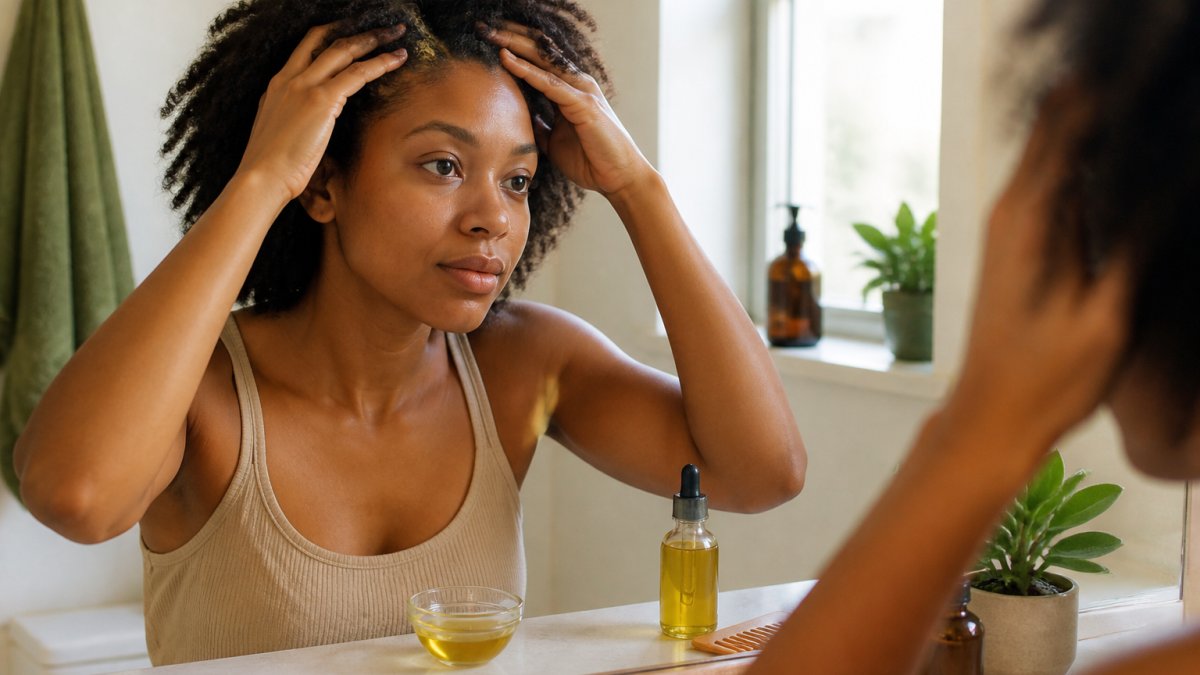
The Core Protocol
- Patch test first. Mix your diluted blend, then dab a small amount behind your ear or on your inner forearm. Wait 24 hours. If you see redness, itching, or swelling, stop and do not use that oil.
- Start with clean, dry hair. Oil absorbs better on a scalp that is not coated in product or heavy buildup.
- Section your hair. Use clips to expose the scalp in rows, working from front to back so you do not miss patches.
- Apply with a dropper. Use roughly 1 to 2 milliliters total for a full scalp, or about a dropperful, distributed in small dots along each part. Target the scalp, not the strands.
- Massage for five minutes. Use fingertips, not nails, in small circles. The rubbing itself supports circulation, so the massage matters as much as the oil.
- Leave it on for 30 minutes minimum. For dry scalps, overnight is fine if you protect your pillow. For oily or fine hair, 30 to 60 minutes is enough.
- Wash gently. Use a mild shampoo. You may need two lathers to fully remove a heavy carrier oil like castor.
- Repeat two to three times weekly. Consistency beats intensity. Daily application is not required and can cause buildup.
Dilution Ratios and Patch Testing
Essential oils are the part that can hurt you, so the math matters. A common safe range is 1 to 2 percent essential oil in a carrier oil. That works out to roughly:
- 1 percent: about 6 drops of essential oil per ounce of carrier
- 2 percent: about 12 drops of essential oil per ounce of carrier
Start at 1 percent. If your scalp tolerates it after two weeks, you can move toward 2 percent. Never apply an essential oil neat, and never add drops directly to your scalp without a carrier.
Patch testing is not optional, and it is not a one-time thing. Test every new oil or blend, because sensitivities can develop with repeated exposure. Keep essential oils away from your eyes, and wash your hands after mixing. If your scalp stings, burns, or blisters, wash it out with mild shampoo and stop using that oil.
Adjusting the Protocol by Hair Type
The same protocol does not fit every head. Heavy oils sit on fine hair and weigh it down; they also clog an already oily scalp. Light oils disappear on fine hair but may not be enough for coily hair that needs more slip.
- Fine or thin hair: use lightweight carriers like jojoba, grapeseed, or argan. Keep contact time to 30 minutes and wash thoroughly. Skip castor as a base.
- Curly or coily hair: heavier carriers like coconut, olive, or castor work well as a pre-wash treatment. Overnight application is usually tolerable.
- Oily scalp: oil the ends and mid-lengths more than the scalp, or use a light carrier and shorter contact time. Watch for buildup.
- Dry or sensitive scalp: start with a single carrier oil and no essential oils for the first two weeks, then add one essential oil at a time.
- Color-treated hair: most carrier oils are fine, but check that your blend does not contain ingredients that strip color. Keep essential oil concentrations low.
Tracking Results: What to Measure and When
Measure three things, once a month, on the same day each month:
- Shedding count: count hairs lost during washing. A rough baseline is helpful; a sudden jump is a reason to see a doctor, not to add more oil.
- Breakage: look for short broken pieces on your pillow, brush, or bathroom floor. Fewer broken pieces is the most realistic early win.
- Photos: same lighting, same angle, same wet-or-dry state, same day each month. Phone photos in consistent light are enough.
Hair grows slowly, roughly half an inch per month, so the earliest visible change from any routine is usually around eight to twelve weeks. Give a protocol a full three to six months before you judge it. Change one variable at a time, so you know what actually worked.
Rosemary Oil for Hair Growth: The Most Studied Option
Rosemary oil for hair growth earns its reputation because it is the essential oil with the most human research behind it.
How to use it: dilute rosemary essential oil to 1-2% in jojoba or coconut oil, massage into the scalp, and leave it for 30 minutes before washing.
One caution: rosemary is not for everyone. Skip it during pregnancy and if you have a seizure disorder.
Essential Oils for Hair Growth: Safe Use and Realistic Limits
Essential oils for hair growth can support a healthy scalp, but they are supporting actors. Peppermint, lavender, and tea tree each bring something different:
- Peppermint: cooling sensation, may support circulation
- Lavender: calming scent, gentle on most scalps
- Tea tree: helps with flaking and itch
Never apply these undiluted. Essential oils can burn, blister, or trigger allergic reactions on bare skin. Keep them away from your eyes, and wash your hands after mixing.
Realistic limits matter here. Essential oils may improve scalp comfort and reduce irritation. They are not a treatment for pattern baldness.
Choosing Quality Oils: Ingredient and Product Checks
Quality decides whether an oil helps or just sits there. Cold-pressed, unrefined oils keep more of their natural compounds.
Check these before you buy:
- Ingredient list: one oil, or a short, clear blend
- "Fragrance" on the label: a sign of synthetic additives
- Packaging: dark glass protects oils from light damage
- Scent: fresh and nutty, not sharp or rancid
- Certifications: organic seals where you can find them
At Lauderma, we build our botanical formulas around plant-based ingredients and full transparency, so you know what is going into your routine and why.
The FDA's guidance on cosmetic labeling is a useful reference for reading ingredient lists properly.
Hair thinning is frustrating, and the internet makes it worse with promises no oil can keep.
That is exactly where Lauderma fits.
Get started with Lauderma and give your hair the consistent, botanical care it has been missing. Claim My 15% Off
Frequently Asked Questions
What is the best natural oil for hair regrowth?
No single oil regrows hair on its own, but rosemary oil has the most clinical evidence for supporting growth, with studies showing results comparable to some standard treatments when used consistently. Castor oil and pumpkin seed oil also show promise in smaller studies. The best choice depends on your hair type and scalp condition. For most people, a blend of a carrier oil like jojoba or argan with a diluted essential oil such as rosemary works well.
How often should you use hair growth oil?
Two to three times per week is a practical starting point. Apply the oil to your scalp, massage for five minutes, and leave it on for at least 30 minutes or overnight before washing it out. Daily use is not necessary and can lead to buildup or irritation. If your scalp feels sensitive, reduce frequency to once a week and check how your skin responds before increasing.
Can essential oils be applied directly to the scalp?
No. Essential oils are highly concentrated and can cause irritation, burning, or allergic reactions if applied undiluted. Always mix them with a carrier oil such as coconut, olive, or jojoba at a ratio of about 2 to 3 drops of essential oil per teaspoon of carrier oil. Perform a patch test on your inner arm 24 hours before using the blend on your scalp, especially if you have sensitive skin.
Do natural oils actually help hair grow?
Natural oils can support hair health by reducing breakage, moisturizing the scalp, and improving blood circulation through massage, but they are not proven to treat significant hair loss on their own. Many people mistake reduced shedding for new growth. If you have sudden thinning, patches of hair loss, or scalp inflammation, see a dermatologist. Oils work best as part of a routine that includes gentle cleansing and consistent scalp care.