

LTable of Contents
- Is Expensive Skincare Worth It? What the Price Tag Really Tells You
- Luxury Skincare vs Drugstore Skincare: Where the Money Actually Goes
- How Active Ingredients and Concentration Affect Product Performance
- Cost Per Use: The Calculation That Changes the Verdict
- Skincare Products Worth Splurging On (And What to Buy Cheap)
- Affordable Skincare Alternatives That Still Deliver Results
- Skin Type, Irritation, and When a Higher Price Is Justified
- Conclusion: Building a Routine That Earns Its Price
- Frequently Asked Questions
Last Updated: October 19, 2026
Is Expensive Skincare Worth It? What the Price Tag Really Tells You
Is expensive skincare worth it? Sometimes yes, often no, and the price on the label is a poor guide to which is which.
Below, we'll show you how to tell drugstore staples from luxury skincare lines using ingredient lists, cost per use, and realistic timelines instead of marketing copy.
Most guides treat price as a quality signal. It isn't. Price bundles ingredients, packaging, fragrance, marketing, and margin, only the first reliably affects your skin.
Luxury Skincare vs Drugstore Skincare: Where the Money Actually Goes
The gap between luxury skincare and drugstore skincare is rarely a secret ingredient. It's how much of each ingredient you get, how the formula is built around it, and how pleasant it feels going on.
A luxury serum and a budget serum can list the same active. What separates them is concentration, delivery system, and stability over months of use, all of which cost money, as do glass bottles, airless pumps, and fragrance.
Formulation and Concentration: The Real Cost Drivers
Concentration is the biggest legitimate reason to pay more. An active near the bottom of an ingredient list does little, no matter how prominent the marketing makes it; a formula that puts it high in the list, at a level shown to work, costs more to make.
Formulation skill matters too. Actives need the right pH, partner ingredients, and protection from light and air; a well-built formula stays stable, while a cheap one may lose potency before you finish the bottle.
Packaging, Fragrance, and Texture: Paying for the Experience
Texture and fragrance are where budgets quietly go. A whipped cream that melts into skin, a serum that disappears without tackiness, a spa-like scent, all of it costs money and none of it changes your skin.
That doesn't make it worthless: if a product feels good, you'll use it daily, and daily use produces visible results. But you're paying for consistency of habit, not a stronger active.
How Active Ingredients and Concentration Affect Product Performance
Product performance comes down to three things: which active is in the formula, how much is there, and whether your skin tolerates it long enough to see a change. Judge an expensive product by comparing it head-to-head with a cheaper option on those three dimensions, not on the label or the price.
A Head-to-Head Comparison Framework
Instead of asking "is this serum worth $80?", ask "does it deliver the same active, at a comparable concentration, in a formula as stable as the $20 one?" Build a four-column comparison for any two products:
What to Compare |
Where to Find It |
What a Good Sign Looks Like |
What to Treat With Suspicion |
|---|---|---|---|
Active ingredient |
Ingredient list |
The active you need is named clearly |
"Proprietary complex" with no named active |
Concentration |
Label, brand site, or customer service |
Disclosed percentage or clearly high list position |
No disclosure and active buried after preservatives |
Formulation |
Ingredient list order, packaging |
Active high in the list, airless or opaque packaging, pH-appropriate partners |
Active near the bottom, clear jar for a light-sensitive active |
Price per use |
Price ÷ realistic applications |
Comparable or lower than the alternative |
Much higher for the same active and concentration |
Run this on the two or three products you're deciding between. Most of the time the cheaper product wins on at least two columns, which tells you where the extra money is going.
Reading the Ingredient List in Order
In the U.S., ingredients are listed in descending order of weight down to 1%, after which they can appear in any order. Anything after the 1% mark may be present at a fraction of a percent, often too little to do what the marketing claims.
Then match the active to the job, and compare like with like:
- Vitamin C for brightness and uneven tone. Look for a stable form such as sodium ascorbyl phosphate or ascorbyl glucoside, and compare disclosed percentages rather than assuming a higher price means a higher concentration.
- Niacinamide for oil balance, redness, and clarity. It is inexpensive to formulate, so a budget serum and a luxury serum at the same percentage are functionally close.
- Hyaluronic acid for hydration and plumping. Molecular weight and the humectant blend around it matter more than the price of the bottle.
Concentration cuts both ways. More isn't automatically better. The American Academy of Dermatology's guidance on skin care makes the same point: gentle, consistent routines beat aggressive ones for most people.

Cost Per Use: The Calculation That Changes the Verdict
Cost per use is the price of a product divided by the applications you realistically get from it.
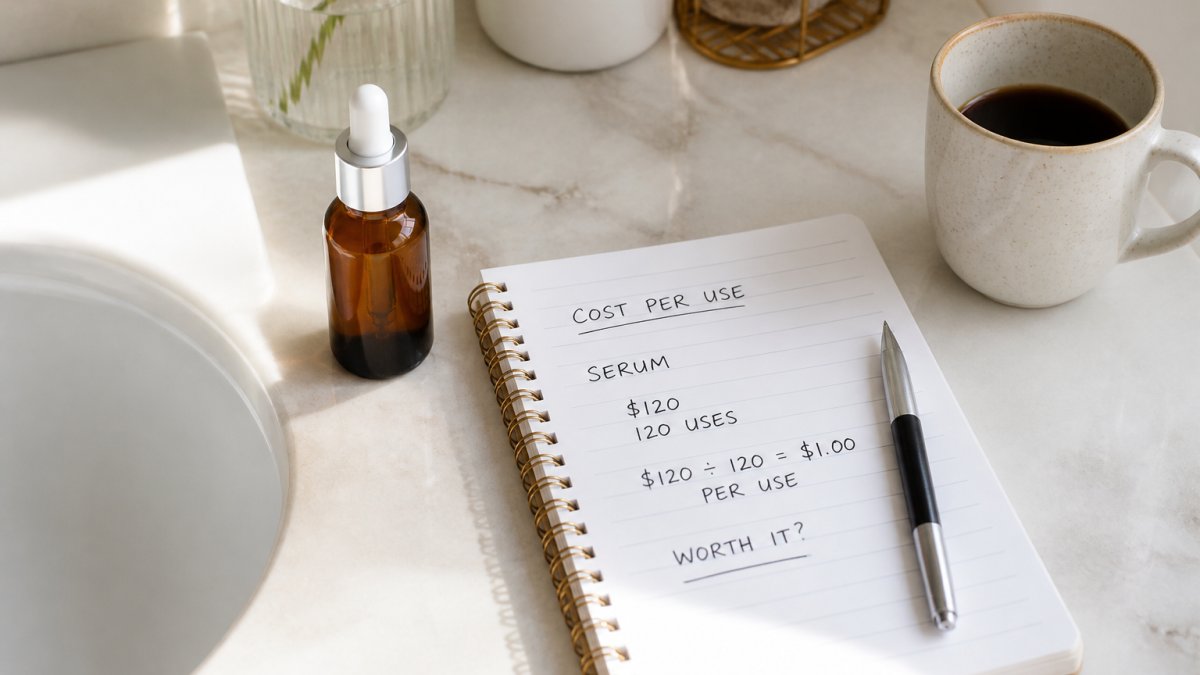
To run the math, note the volume on the label, estimate drops or pumps per application, and divide.
Product Type |
Typical Size |
Uses per Bottle |
What Drives Cost Per Use |
|---|---|---|---|
Serum |
30 ml |
60-90 |
Drops per application, frequency |
Moisturizer |
50 ml |
90-120 |
Amount per use, face and neck |
Cleanser |
150 ml |
60-90 |
Lather volume, twice-daily use |
Sunscreen |
50 ml |
25-35 |
Generous application, reapplication |
120 g |
40-60 |
Coverage area, dry patches |
Two lessons: sunscreen and cleanser are used in large amounts, so a pricey version gets expensive fast.

Run the calculation before you decide. A serum at $31.99 that lasts three months costs roughly a dollar a day.
Skincare Products Worth Splurging On (And What to Buy Cheap)
Spend where the formula does the work and the product stays on your skin. Save where it rinses off or gets used in large volumes. That single rule covers most of the skincare products worth splurging on.
Serums and Treatments: Where Concentration Matters Most
Serums are the best place to spend. They carry the highest concentration of actives, sit on skin for hours, and are used in small enough amounts that cost per use stays reasonable, and formulation quality shows up in visible results.
Our Vitamin C facial Serum ($31.99) uses sodium ascorbyl phosphate, a stable vitamin C form, alongside sodium hyaluronate and chamomile extract.
For breakout-prone skin, our Clarifying Acne Facial Serum with Niacinamide ($24.99) pairs niacinamide with witch hazel, willow bark extract, tea tree oil, and hyaluronic acid to support clarity without stripping skin.
Cleansers and Sunscreen: Where Cheap Usually Wins
Cleansers rinse off within a minute, so a luxury cleanser's expensive ingredients have little time to do anything. A gentle, fragrance-free cleanser at a modest price does the job. Save your budget here.
Sunscreen is the same story, with a twist: what matters is that you use enough and reapply. The Skin Cancer Foundation's sunscreen guidance is blunt about this: protection depends on proper application, not price.
Moisturizers sit in the middle. Our Hyaluronic Acid Face & Neck Moisturizing Cream ($29.99) is built around hyaluronic acid for lasting hydration, and the Clarifying Facial Moisturizer ($24.99) targets oily and combination skin with tea tree, rosehip, and calendula.

Affordable Skincare Alternatives That Still Deliver Results
Affordable skincare alternatives work when they keep the active and cut the extras. You don't need a full luxury routine; you need two or three well-chosen products and the discipline to use them.
The most reliable swaps:
- Choose a single-active serum over a ten-ingredient "complex"
- Skip fragrance for known or suspected sensitivity and allergies. Skin patch test recommended when in doubts.
- Buy the largest size of products you use daily, if the formula suits you.
That keeps a routine lean and puts money where it changes your skin. A three-product routine built this way often outperforms a seven-step luxury one, because every product has a job and none fight each other.
Skin Type, Irritation, and When a Higher Price Is Justified
A higher price is justified when the formula solves a problem cheaper products can't and your skin tolerates it. Skin type decides which applies to you; the evidence behind the active decides whether the price buys anything real.
Separating Evidence From Testimonials
Before you pay more for a claim, ask what kind of evidence stands behind it. There are three tiers, and they are not equal:
- Clinical or peer-reviewed evidence. The active has been studied in controlled trials and shows a measurable effect. Retinoids, vitamin C, niacinamide, salicylic acid, and sunscreen all have this kind of backing. Paying more for a well-formulated version of one of these is defensible.
- Brand-funded studies and before-and-after photos. Useful as a signal that the formula was tested, but the results are selected and the comparison is often uncontrolled.
- Testimonials and influencer reviews. Anecdote, not evidence. They tell you how a product feels and whether someone liked it, not whether it works better than a cheaper alternative.
A luxury product is worth the premium when it sits in the first tier and the cheaper alternative does not. It is not worth the premium when the only thing behind it is the second or third tier.
Realistic Timelines for Results
Most people give up before a product has time to work, then conclude the expensive one failed or the cheap one was fine. Set expectations by active:
- Sunscreen and moisturizer: immediate comfort and hydration; protection is cumulative over years.
- Niacinamide and hyaluronic acid: a few weeks for hydration and oil balance.
- Vitamin C: several weeks to a few months for brightness and tone.
A reasonable rule is to give a new active eight to twelve weeks of consistent use before judging it. If you change products every two weeks, you are comparing nothing.
Matching Skin Type to Risk
Sensitive skin is the clearest case for spending carefully. Reactive skin often reacts to fragrance, essential oils, and high-strength actives, not to price.
Oily and acne-prone skin benefits from lightweight, non-comedogenic formulas. The U.S. Food and Drug Administration's guidance on cosmetics and skin products is a useful reference for how products are classified and what claims they can legally make.
Where a higher price earns its place:
- A stable, well-concentrated vitamin C or retinoid with clinical backing
- A moisturizer that hydrates for a full day without irritation
- A formula free of the specific ingredients your skin reacts to
Where it doesn't: cleansers, sunscreens, and anything you're paying for scent or a glass bottle.
Conclusion: Building a Routine That Earns Its Price
The challenge is that skincare rewards patience and punishes impulse. Most people overspend on the wrong products, then give up before results appear.
At Lauderma, we build plant-based formulas with transparent ingredient lists, so you can see what you're paying for.
Build a short routine, run the cost-per-use math, and give it eight to twelve weeks. Then judge. Get started with Lauderma and put your budget where it actually changes your skin.
Frequently Asked Questions
Is it worth spending money on skincare?
It depends on which step in your routine you're funding. Serums and treatments carry active ingredients where concentration and formulation decide whether you see results, so paying more there often makes sense. Cleansers and sunscreen rinse off or sit on the surface, and inexpensive versions can perform just as well. A practical approach is to spend on the two or three products that stay on your skin and save on the ones that don't. Track cost per use rather than sticker price, since a $32 serum used twice daily for three months costs far less per application than it first appears.
Does expensive skincare work better than affordable skincare?
Not automatically. Price reflects formulation, ingredient concentration, packaging, fragrance, testing, and marketing, and only some of those affect how your skin responds. A cheap product built around a proven active at a useful concentration can outperform a costly one built around a trendy extract at a token amount. The reliable way to judge is to read the ingredient list, check where the actives sit in the order, and give a product eight to twelve weeks before deciding. Expensive skincare earns its price when the formula solves a specific problem your skin actually has.
Which skincare products are worth splurging on?
Prioritize leave-on treatments: vitamin C serums, retinoids, exfoliating acids, and targeted serums for acne or dark spots. These are where concentration, stability, and delivery systems separate a formula that works from one that doesn't. A well-made vitamin C serum, for example, needs the right pH and packaging to stay effective, and those choices cost money. Moisturizers sit in the middle: a quality one matters for barrier support, but plenty of affordable options do the job. Cleansers, micellar water, and sunscreen are the safest places to save.
How can you tell whether a skincare product is worth the money?
Start with the ingredient list. Actives should appear before the preservative and fragrance block, not after. Then calculate cost per use by dividing the price by the number of applications the container provides. Next, check whether the product makes a claim you can verify, like a stated percentage of an active, rather than vague language about radiance. Finally, give it a realistic timeline: most actives need eight to twelve weeks of consistent use before visible change. If a product fails the ingredient check or the cost-per-use math, the price isn't justified.